Venetian vs Roller vs Vertical Blinds: Cleaning Differences Explained
Blinds get grouped together as one category, which hides the fact that the three common types have almost nothing in common once you start cleaning them. A venetian is dozens of individual horizontal surfaces. A roller is one continuous coated sheet. A vertical is a set of hanging louvres on a carrier track. Each collects dirt differently, each fails differently, and each needs a different approach.
Venetian Blinds: Surface Area Is the Problem
A venetian blind on an average window may carry sixty or more slats, each with a top and bottom face, which adds up to a remarkable amount of horizontal surface in a small space. When closed, every slat presents an upward face that collects dust exactly like a shelf, and slats near the top of the window collect the most. The result is that a venetian looks acceptable from one angle and obviously dusty from another, and the dust load is far heavier than the visible window area suggests.
What Venetians Are Made Of Changes Everything
Aluminium slats are the most forgiving and tolerate wet cleaning readily, though thin slats crease permanently if bent and the crease catches the light forever. Timber and faux-timber are the opposite: real timber must never be soaked, because water raises the grain, lifts the finish and warps the slat into a curve that no longer sits flat when closed. Faux timber is PVC and handles moisture, but it is heavy and the ladder cords take the strain. Whichever material, the cords and the tilt mechanism are the fragile parts, and forcing a stiff mechanism is how most venetians actually break.
Cleaning Venetians Properly
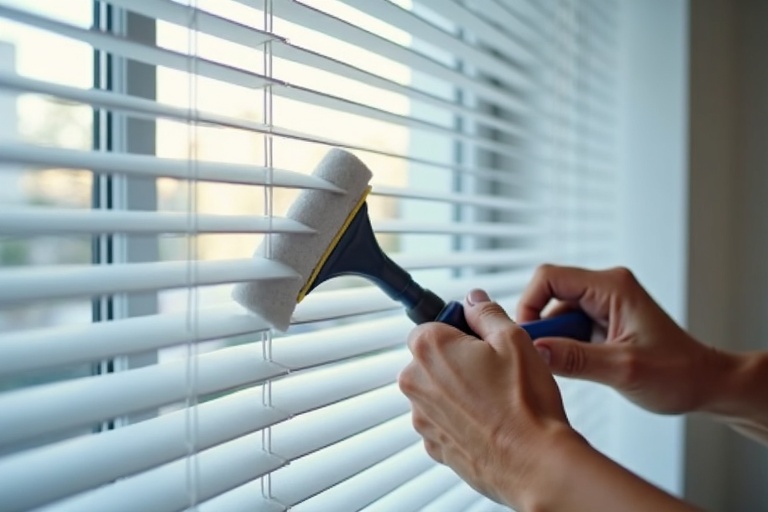
The method that works is slat by slat, with the blind closed one way, then reversed and repeated. Dusting tools with multiple prongs speed it up but do not replace it. For heavy soiling — kitchen grease being the usual case — aluminium and PVC slats can be taken down and immersed, then dried fully before rehanging so no water is trapped in the headrail. Timber is cleaned with barely damp cloths and an appropriate finish restorer, never immersed. Ultrasonic cleaning is available for suitable materials and is the most thorough option for heavily soiled aluminium.
Roller Blinds: One Surface, Very Little Margin
A roller is simpler in every way except tolerance. Most roller fabrics are coated or laminated — for blockout, for sunscreen mesh performance, or simply for stiffness — and that coating is what makes the blind function. Scrub it, soak it, or use a solvent-based cleaner on it and the coating delaminates, bubbles or goes cloudy, which is unfixable and requires a new blind. The fabric also has no seams or slack, so any distortion shows immediately as a blind that tracks crooked and creeps to one side as it rolls.
Cleaning Rollers Without Ruining Them
Roll the blind fully down so the whole surface is exposed, vacuum it with a soft brush head, then wipe gently with a barely damp microfibre cloth using straight horizontal strokes rather than circles. Sunscreen mesh needs particular care because the open weave clogs with fine dust and the fibres are easily distorted. The blind must be completely dry before rolling back up — moisture rolled into the tube causes mould and leaves permanent striping across the fabric. Never machine wash a roller blind under any circumstances.
Vertical Blinds: Bottom-Heavy Soiling
Verticals wear in a distinctive way. Because the louvres hang free and are usually weighted at the bottom with chains or clips, they sway with every draught and catch the dirtiest air in the room — the low-level dust stirred by feet and traffic. That produces a characteristic grubby band across the bottom third of every louvre, most obvious in offices near entrances. The tops meanwhile collect dust from above, so both ends soil while the middle stays comparatively clean.
The Vertical Blind Failure Points
Fabric verticals are usually stiffened with an impregnated finish that gives the louvre its body. Wash it out and the louvre goes limp, curls at the edges and never hangs straight again — which is why bundling them into a washing machine, a widely repeated piece of advice, ruins so many sets. The other weak points are the top hangers, which are small plastic parts that crack with age, and the bottom chain, which drops off and gets lost. PVC verticals are far more tolerant and can be wiped down freely.
Cleaning Verticals Correctly
Rotate the louvres flat so the full face is presented, vacuum each side with a soft brush, then spot-treat the soiled lower band with minimal moisture and immediate blotting. Where louvres need more, they can be detached individually, laid flat and cleaned by hand — labour-intensive but safe. Take the opportunity to check every hanger while they are down, since replacing a cracked hanger costs almost nothing compared with an emergency callout after a louvre falls.
Comparing the Three Directly
- Dust load: venetians worst by a distance, verticals moderate, rollers lightest.
- Time to clean properly: venetians slowest, verticals moderate, rollers quickest.
- Risk of permanent damage: rollers highest, because of the coating; venetians lowest in aluminium.
- Wet cleaning tolerance: aluminium and PVC yes; timber, coated rollers and fabric verticals no.
- Typical failure: venetian cords and tilt, roller coating and tracking, vertical hangers and chains.
- Suggested interval: venetians every six months, verticals six to twelve, rollers annually.
Where Professional Cleaning Earns Its Place
Light dusting is genuinely a home job on all three. Everything past that is where blinds get damaged: grease-laden kitchen venetians, sunscreen mesh that has clogged, verticals that have lost their stiffening, and any timber slat that has already been wet once. Correct handling means identifying the material first and matching the method to it, which is the core of professional blinds cleaning, and for large sites it is normally folded into a wider commercial cleaning program alongside the drapery.
Keeping Them Working Longer
Operate every blind through its full range regularly, so cords and mechanisms do not seize. Never force a stiff control. Dust before the film becomes greasy, because dry dust wipes away while oil-bound dust needs treatment. And when blinds and curtains share a house, clean them together — the team at Fresho Curtain Cleaning handles both in one visit, matching the method to each material so nothing is treated as a one-size-fits-all job.