What's Living in Your Curtains: Dust, Pollen and Odour Explained
Curtains are the largest piece of textile in most rooms, they hang directly in the path of every draught, and nobody moves them for months at a time. That combination turns them into passive air filters — except unlike a filter, they are never changed. Understanding what accumulates in the weave, and why it stays there, explains why a vacuum only gets you part of the way and why some smells refuse to leave a room.
Why Fabric Catches So Much
Two forces are at work. The first is simple interception: air moving through a window carries particles, and a loose woven fabric strains them out much as a net strains water. The second is static. Synthetic fibres such as polyester carry a mild electrostatic charge that actively pulls fine dust towards the surface and holds it there against gravity. This is why curtains stay dusty even when the floor beneath them looks spotless, and why a light dusting redistributes the problem instead of solving it.
Household Dust Is Mostly You
Household dust is far less exotic than people imagine. The bulk of it is shed skin, textile fibres from clothing and bedding, hair, paper fragments and soil tracked in on shoes. On its own that mixture is inert and vacuums away. The problem starts when humidity, cooking vapour or condensation binds it to the fibre. At that point it stops behaving like loose dust and starts behaving like a stain, which is why an old curtain can look grey and lifeless even after a thorough vacuum.
Dust Mites and What They Leave Behind
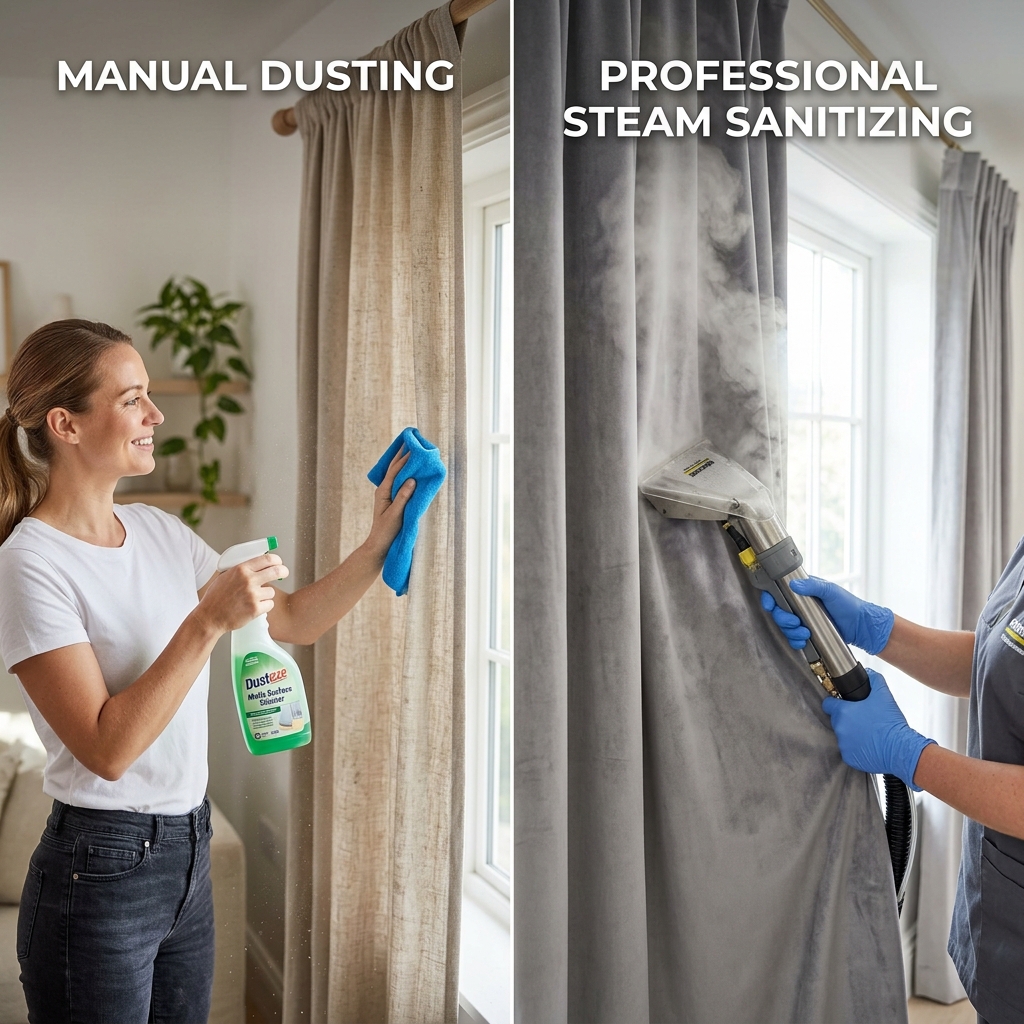
Dust mites are microscopic arachnids that eat shed skin and need warmth and humidity to breed. Lined and blockout curtains give them exactly that: a dark, still, insulated space that nothing disturbs. It is not the mites themselves that trigger reactions but the protein in their droppings, which is light enough to become airborne every time the curtain is pulled. Because those particles are bound into the fabric rather than sitting on top of it, only heat and moisture reliably deal with them — the reason steam cleaning is the standard recommendation for allergy-affected households.
Pollen Arrives in Spring and Stays All Year
Pollen grains have textured, sometimes barbed surfaces that cling to woven fibres remarkably well. An open window during a high-count day deposits an enormous quantity into the curtain directly beside it, and that pollen does not degrade quickly indoors. This is the usual explanation when someone finds themselves sneezing through winter in a closed house: the curtain is still holding several months of accumulated grains and releasing a small cloud every time it is drawn.
Cooking Oil and the Grey Film
Frying, roasting and even boiling put a fine aerosol of oil into the air, and it travels much further through an open-plan home than most people expect. It settles on curtains as an invisible tacky layer that then captures every passing dust particle. Over a year or two, that layer oxidises, turns yellow-brown and pulls the fabric colour down with it. Detergent chemistry, not suction, is what lifts it, and the longer it is left the more work it takes.
Mould and Mildew Behind the Lining
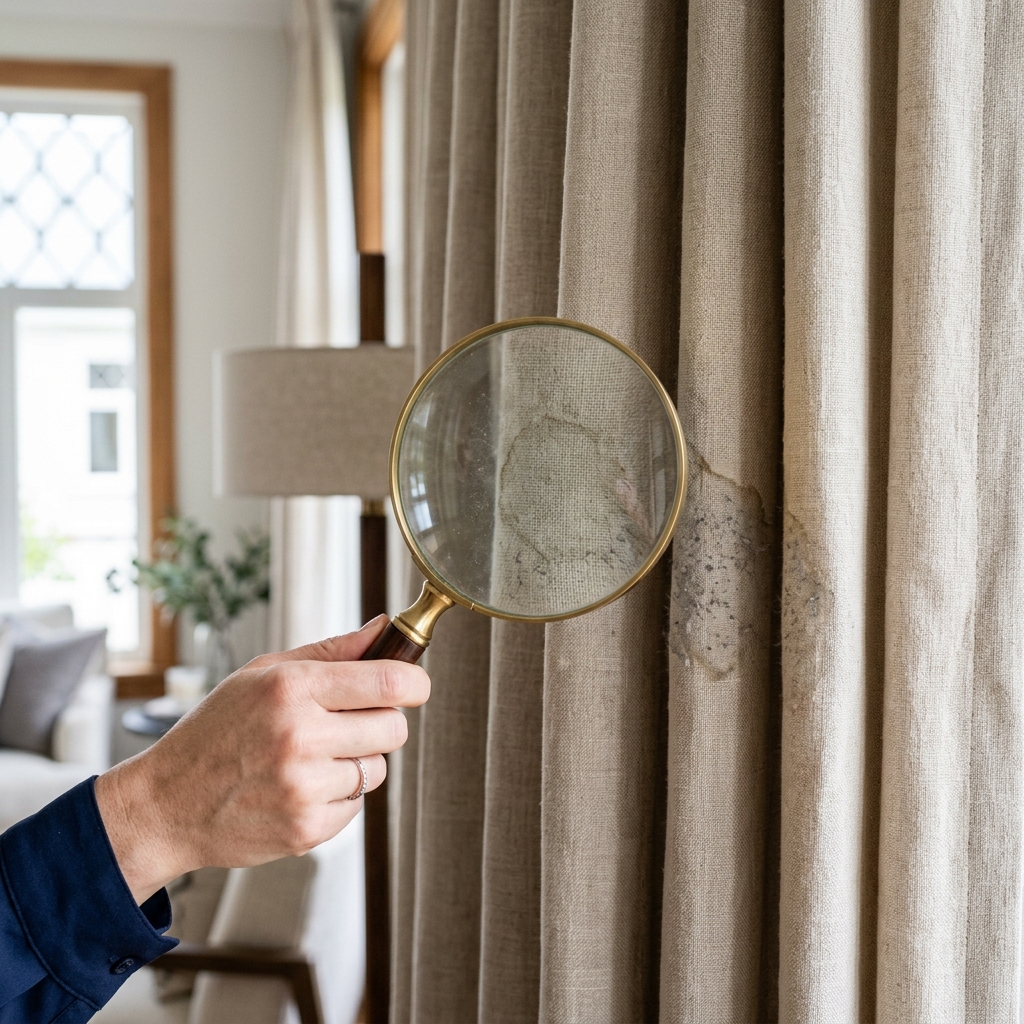
Condensation forms on cold glass overnight and transfers to whatever is touching it. In winter, the back of a lined curtain against a single-glazed window can stay damp for hours each morning. That is enough for mould to establish, usually starting along the bottom hem or the lining edge where moisture pools. Visible black spotting is a late-stage symptom; the musty smell in a closed bedroom arrives long before it, and it is a signal worth acting on immediately.
Why Odour Behaves Differently to Dirt
Smell is not a coating on the surface — it is molecules absorbed into the fibre itself. Tobacco smoke, curry, pet urine, damp and smoke haze all leave volatile compounds lodged inside the material, and they release slowly for months. Air fresheners and fabric sprays only mask them, and many leave a sticky residue that attracts more dust than it hides. Genuine odour removal means flushing the compounds out of the fibre, which is a targeted odour and stain treatment rather than a rinse.
Pet Dander, Hair and Insects
Dander is skin, not hair, and it is fine enough to remain suspended in the air for hours before settling into whatever soft surface it meets. Hair works into the weave and mats, particularly on textured fabrics. Curtains also collect what you would rather not think about — spider webs behind the header, dead insects in the bottom fold, and the occasional moth attracted to wool or silk content in a heavier drape.
The Damage Beyond Hygiene
There is a structural cost to leaving all of this in place. Dust and grit are mildly abrasive, and every time a loaded curtain moves in a draught or is pulled across a track, those particles saw against the fibres. Combined with UV exposure through the glass, that shortens the working life of the fabric considerably. Cleaning on a sensible schedule is genuinely cheaper than replacing curtains early, which is the argument we make most often when quoting home curtain cleaning.
What You Can Do Between Cleans
Vacuum with an upholstery head every four to six weeks, working top to bottom and paying attention to the header and the hem where the heaviest deposits sit. Use a machine with proper filtration, otherwise the fine fraction goes straight back into the room. Wipe condensation off the glass in winter before it migrates into the fabric, and air the room properly rather than relying on scent. None of this replaces a deep clean, but it slows the accumulation considerably.
Getting It Properly Out
Each of these deposits responds to something different — heat for mites, detergent chemistry for oils, extraction for embedded particulate, targeted treatment for absorbed odour. That is the reason Fresho Curtain Cleaning assesses fabric and soiling before choosing a method, and why our range of cleaning services is split by fabric type and problem rather than sold as one universal treatment.