Why Some Curtains Shrink When Cleaned at Home
Few household mishaps are as final as a shrunken curtain. The panel goes into the machine reaching the floor and comes out hovering above the skirting board, with puckered seams and a lining that no longer matches the face fabric. It is not bad luck and it is not random. Shrinkage happens for a small number of well-understood reasons, and once you know what they are, most of it becomes avoidable.
What Shrinkage Actually Is
Fabric is made from yarn that has been pulled under tension during spinning and weaving, and finished under tension again at the mill. Those fibres are effectively held stretched. Introduce water and heat, and the fibre swells, softens and relaxes back towards its natural length. The weave tightens, the panel gets shorter and often narrower, and nothing you do afterwards will fully reverse it. This is called relaxation shrinkage, and it is why the first wash is nearly always the destructive one.
Natural Fibres Are the Usual Casualties
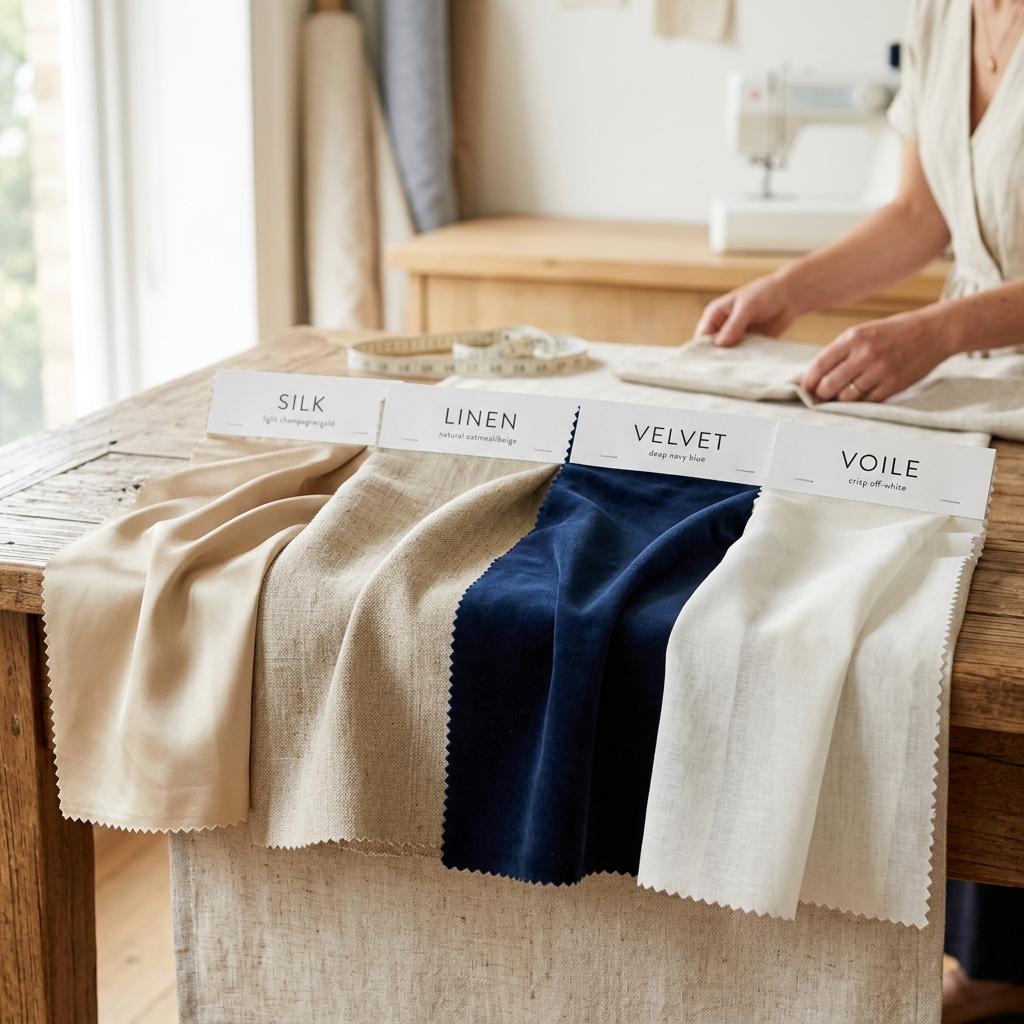
Cotton, linen and viscose absorb water into the fibre structure itself rather than simply carrying it on the surface. They swell substantially when wet, which is exactly the condition that lets the yarn contract. Linen is the most dramatic of the three and can lose a noticeable amount of length in a single warm wash. Wool has a different problem entirely: its scaled fibre surface interlocks under agitation and heat, a process called felting, which mats the fabric permanently and cannot be undone.
Synthetics Fail in a Different Way
Polyester and nylon barely absorb water, so they rarely shrink from wetting alone. Their weakness is heat. These fibres are set thermally during manufacture, and taking them past that setting temperature — in a hot wash or, far more commonly, a tumble dryer — causes them to contract and distort. The result is usually worse than plain shrinkage: rippled hems, a wavy leading edge, and a permanent glazed shine where the fabric has effectively been part-melted.
Linings Are the Hidden Trap
Most quality curtains are two or three fabrics sewn together: a face fabric, a lining, and sometimes an interlining. These are frequently different materials from different suppliers, and they shrink at different rates. A cotton lining behind a polyester face is the classic mismatch — the lining pulls up, the face fabric does not, and the panel ends up bubbled and twisted along its length even though neither fabric has been damaged on its own. This is the single most common reason a home-washed lined curtain never hangs properly again.
Blockout Coatings Do Not Survive Machines
Blockout and thermal curtains achieve their opacity with an acrylic or foam coating bonded to the back of the fabric. That coating is not woven in; it is applied as a layer. Heat softens it and mechanical agitation cracks it, so the coating flakes, peels away in sheets and blocks the machine filter. The base fabric then shrinks freely because the stabilising layer that was holding it flat has gone. A blockout curtain is effectively a single-use item in a washing machine.
Weight and Agitation Do the Rest
A dry pair of lined drapes is heavy. Wet, it can be three or four times heavier, and a domestic drum was never designed to carry that mass. The load slams around instead of tumbling, which stresses seams, pulls stitching through the fabric and stretches the header tape while the body contracts. So you can end up with the worst of both outcomes at once: a panel that is shorter overall but wider and rippled at the top where the tape has been distorted.
Drying Causes as Much Damage as Washing
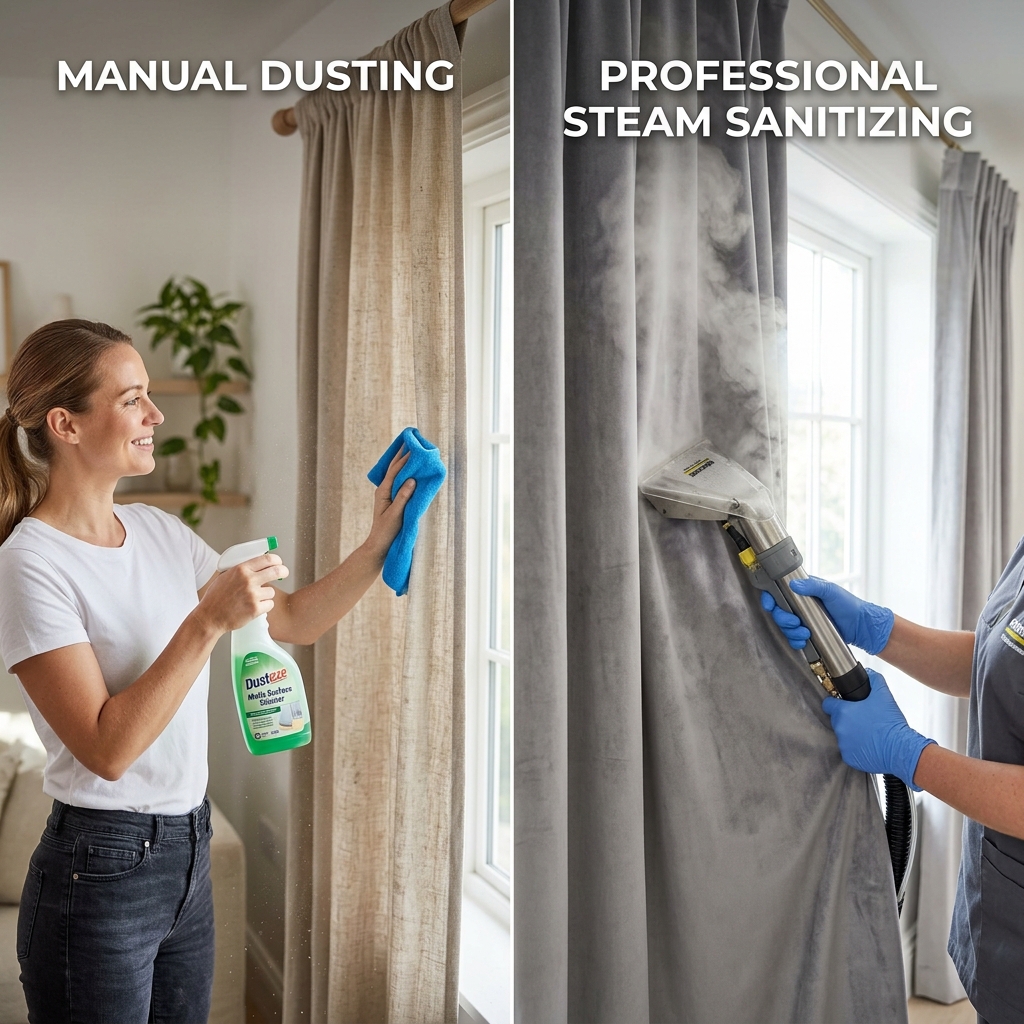
A tumble dryer combines every risk factor — high heat, continuous agitation and rapid moisture loss — and it is where most curtain shrinkage is actually finalised. Line drying has its own hazard: hanging a saturated panel from pegs concentrates all that weight on a few points, which stretches the top and can leave permanent peg marks. Fabric should dry supported along its full length, ideally hanging in place, which is precisely what onsite methods are designed to allow.
Why Professional Cleaning Avoids It
Controlled methods sidestep the entire problem. In onsite steam cleaning the curtain stays on its track under its own weight, the moisture introduced is a fraction of a wash cycle, and there is no drum agitation at all. The fabric never becomes saturated enough for relaxation shrinkage to take hold, and the panel dries hanging in the shape it is meant to hold. Where a fabric genuinely cannot take moisture, a solvent process is used instead.
Reading the Warning Signs Before You Wash
- Any care label reading dry clean only, or showing a circle symbol, means exactly that.
- A separate lining that moves independently of the face fabric when you pinch the hem.
- A rubbery, plasticky or slightly stiff back surface — that is a blockout coating.
- Visible interlining: a soft, insulating third layer between face and lining.
- Bright, saturated colours on cotton or linen, which also carry a dye-bleeding risk.
- A curtain cut to sit exactly at floor level, where even two per cent of loss will show.
If It Has Already Happened
Options are limited but not zero. A cotton or linen panel can sometimes be recovered a little by damp-stretching it back on a frame while it dries, and a good curtain maker can occasionally let down a generous hem allowance to buy back a few centimetres. Felted wool and cracked blockout coatings are permanent. Puckering caused by mismatched linings can occasionally be improved by unpicking and re-hanging the lining, which is specialist work of the kind involved in formal drapery cleaning.
The Safer Path
Unlined cotton or polyester sheers with no coating are usually fine at home in cold water on a gentle cycle, hung damp to dry. Anything lined, coated, interlined or made from natural fibre with a precise drop is worth handing over, and a professional assessment before cleaning costs far less than replacing a set of curtains. If you are unsure which category yours fall into, Fresho Curtain Cleaning can identify the fabric and construction before anything gets wet.