Why DIY Curtain Cleaning Sometimes Makes Things Worse
A good proportion of the difficult jobs we are called to were not difficult to begin with. Somebody spotted a mark, reached for whatever was under the sink, and made a small localised problem into a large permanent one. Doing it yourself is not automatically wrong — plenty of curtain maintenance is genuinely a home job. But a handful of common instincts cause real damage, and they are worth knowing before the cloth comes out.
Rubbing Is the Reflex That Costs the Most
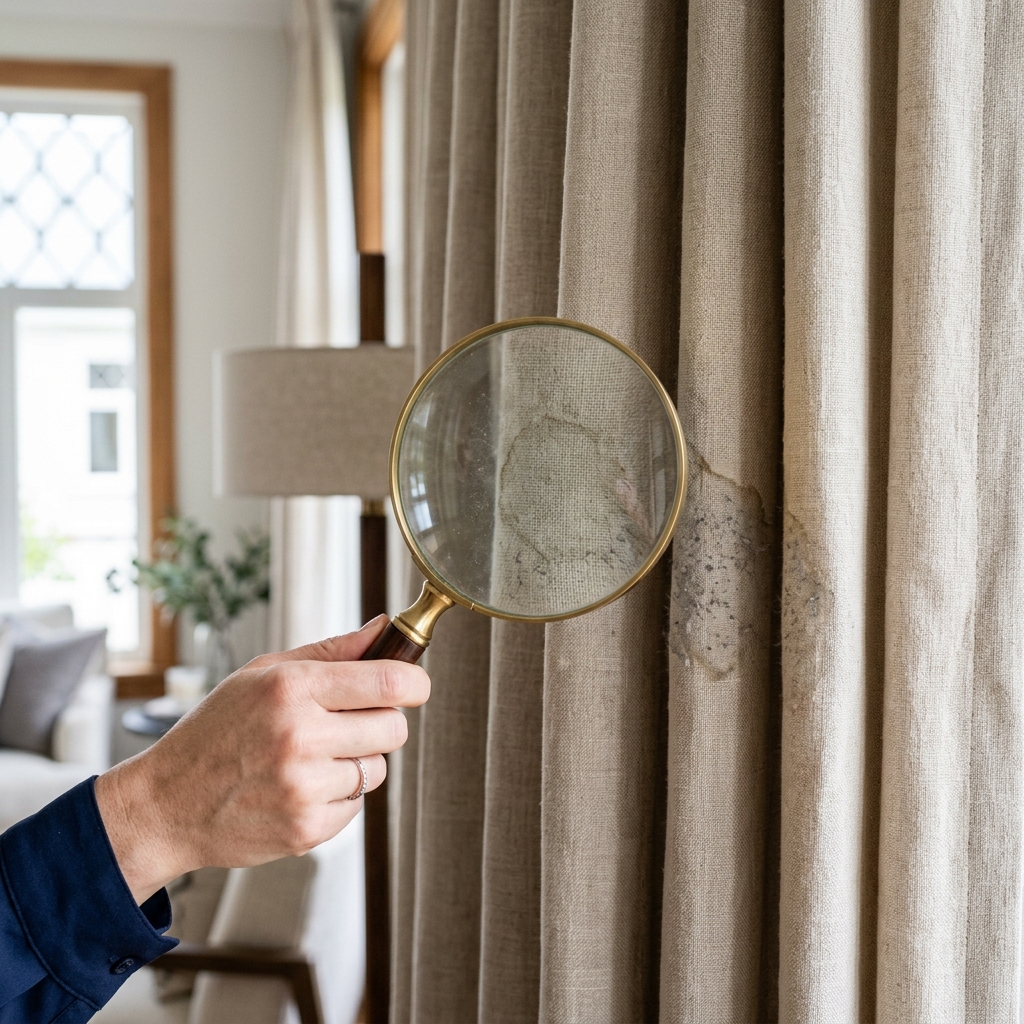
Everybody rubs. It feels like effort translating into progress. What it actually does is push the staining material sideways and deeper into the weave, turning a two-centimetre spot into a ten-centimetre halo, and it abrades the fibre surface. On anything with a pile or a sheen — velvet, silk, satin, faux suede — the abrasion is instantly visible as a dull, roughened patch that stays there after the stain itself has gone. Blotting with a clean white cloth, pressing rather than scrubbing, and working inward from the edge does nearly everything rubbing does without the damage.
Water Rings Where the Stain Used to Be
Spot-cleaning with plain water on a hanging curtain creates a wet patch that dries outwards. Every dissolved soil and mineral in the fabric migrates to the edge of that patch and deposits there as the moisture evaporates, leaving a distinct ring. On dense or dark fabrics the ring can be more conspicuous than the original mark. The fix requires re-wetting the whole panel evenly and drying it under controlled conditions, which is a great deal more work than treating the spot correctly would have been.
Heat Sets Stains Permanently
Protein-based marks — blood, milk, egg, pet accidents — coagulate when heated, bonding to the fibre in a way that nothing will lift afterwards. Sugars caramelise. Many dyes react and shift. So the instinctive response of hot water and vigorous work is the exact wrong move for a large class of stains, and the same applies to putting a stained panel in a warm dryer before checking the mark has actually gone.
Household Products That Should Not Touch Curtains
Chlorine bleach damages the fibre as well as the colour, and on synthetics it can leave a yellow cast that is worse than the stain. Undiluted vinegar and lemon juice are acidic enough to strip dye from silk and wool. Bicarbonate paste is abrasive and lodges in the weave, drying to a chalky bloom. Oxygen boosters that are fine on cotton bedding will strip a blockout coating. And dishwashing liquid, the universal fallback, is heavily concentrated and foams so much that rinsing it fully out of a hanging panel is nearly impossible — the residue then attracts dust faster than the original soil did.
Skipping the Patch Test
Every professional treatment starts with a test on a hidden area — a hem allowance, the back of the header, a return edge — waiting for it to dry and checking for colour movement. It takes a few minutes and it is the single step most often skipped at home. Dye bleeding is not always immediate, either; a colour can look stable while wet and reveal a pale patch or a bled outline hours later once the fabric is fully dry.
The Steam Mop Problem
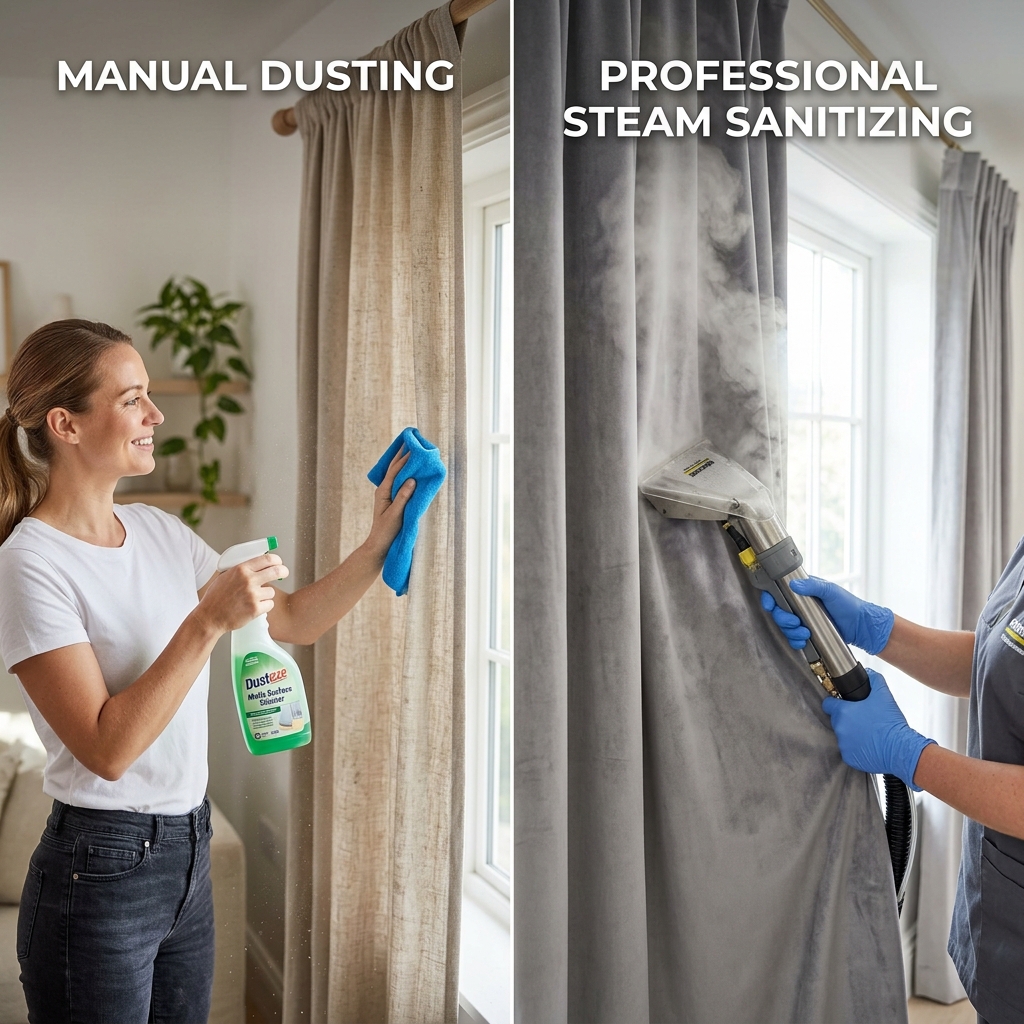
A domestic steam mop or garment steamer looks like the same tool a professional uses. It is not. The difference is control and recovery: commercial equipment regulates temperature and moisture precisely and extracts what it puts in, whereas a household unit dumps uncontrolled wet steam into the fabric with no way of taking it back out. On coated blockouts the heat softens the backing, on natural fibres the moisture triggers shrinkage, and on lined panels the water soaks through to the interlining where it can sit damp for days and go musty. Proper professional steam cleaning works because of the extraction stage, not the steam alone.
Machine Washing the Wrong Panel
Wet curtains are extraordinarily heavy, and a domestic drum handles that load badly. Header tapes stretch, hook pockets tear out, weighted hems break loose, and seams pull. Add the mismatched shrink rates of face fabric and lining, and a panel can come out of the machine technically clean but structurally finished. If a curtain is lined, coated or made from anything you cannot confidently identify, the machine is not the place for it.
Masking Odour Instead of Removing It
Fabric sprays and air fresheners sit on top of the smell rather than removing it, and most leave a light polymer film that holds dust. Two or three months of that builds a genuinely grubby layer over the top of the original problem, and the underlying odour compounds are still lodged in the fibre. Smoke, pet urine and mould all need to be flushed out with targeted odour and stain removal, because they are absorbed into the material rather than resting on it.
Why the Second Attempt Is Always Harder
Failed home treatment does not leave a neutral starting point. There is now detergent residue changing how the next product behaves, possible dye movement, a water ring, abrasion, and a stain that has been heat-set. That is why a job quoted after a DIY attempt often takes longer and carries more caveats than the same job would have before — the original stain is frequently no longer the main problem.
What Is Genuinely Safe to Do Yourself
- Regular vacuuming with an upholstery head, top to bottom, on any fabric.
- Immediate blotting of a fresh spill with a dry white cloth, no product at all.
- Airing the room and opening windows to shift light, recent odours.
- Cold-water washing of unlined, uncoated polyester or cotton sheers.
- Wiping condensation off glass before it reaches the lining.
- Lint-rolling pet hair from smooth-faced fabrics.
Knowing Where the Line Is
The dividing line is fairly clear: routine maintenance on fabric you can identify is a home job, while anything lined, coated, delicate, valuable or already stained is not. When a mark has resisted one careful attempt, stopping there rather than escalating is the decision that keeps the curtain recoverable. The specialist cleaning services at Fresho Curtain Cleaning exist for exactly the jobs on the far side of that line.